Which Country Has the Best Luxury Safari? Kenya, Tanzania, Botswana, South Africa and Rwanda Compared
No country is best at everything. The line that decides it is whether you may leave the road — and the fees on top of the bed differ more between countries than between camps.
- No country is best at everything; what decides it is whether you may leave the road.
- Kenya, Botswana and South Africa permit off-road, night drives and walking on private land.
- Tanzania's national parks permit neither off-road driving nor night drives, and walking only as ranger-led outings in parks such as Tarangire and the Serengeti.
- Rates sit at roughly US$1,500 per person per night across the region.
- What differs between countries is what sits on top of the bed, not the camps.
- South Africa enters from US$1,200 per person per night and charges nothing at a gate.
- Rwanda's gorilla permit is US$1,500 per person per trek, secured before flights.
The short answer
There is no country that is best at everything, but the line that decides it is narrower than most comparisons admit, and it is not the lodges. It is whether you may leave the road. Kenya's private conservancies, Botswana's concessions and South Africa's Sabi Sand and Timbavati all permit off-road driving to reach a sighting, night drives and guided walking. Tanzania's national parks permit neither off-road driving nor night drives, and walking only as ranger-led outings in parks such as Tarangire and the Serengeti. Two camps of identical standard, one either side of that line, are not selling the same holiday.
The second deciding factor is where the money goes. At roughly US$1,500 per person per night across the region, what differs is how much sits on top of the bed — and the gap between countries is larger than the gap between camps.
| Country | From, per person per night | Park fees on top of the bed | Off-road · night drives · walking | Best months |
|---|---|---|---|---|
| Kenya | ~US$1,500 | Mara reserve US$100 per person per day Jan–Jun, US$200 Jul–Dec; conservancies charge US$80–150 per person per night instead, usually inside the camp rate | Yes, in the private conservancies | June – October |
| Tanzania | ~US$1,500 (Serengeti migration camps from US$1,800 in season) | Serengeti US$70.80 in peak plus 18% VAT per person per day; Ngorongoro US$70.80 per adult and a further US$295 per vehicle to descend to the crater floor | No off-road or night drives in the national parks; ranger-led walks in some parks | June – October |
| Botswana | from US$1,200 | P270, roughly US$20 per person per day at Moremi and Chobe | Yes, in the private concessions | May – October |
| South Africa | from US$1,200; ~US$1,500 typical | None at a gate — the private reserves fold their conservation levy into the rate | Yes, in Sabi Sand and Timbavati | June – October |
| Rwanda | ~US$2,000, permits separate | Gorilla permit US$1,500 per person per trek, eight visitors per family | Trekking, not game drives | June – September · December – February |
What the fees actually add
Tanzania is the clearest case, and it is worth doing the arithmetic before choosing on nightly rate alone. Two travellers on a ten-night northern circuit carry well over US$1,500 in park fees before a single night is paid for. That is part of why Serengeti camps quote from US$1,800 per person per night in season. A private vehicle — which buys the departure time, the right to sit with a leopard for an hour and a row of your own for a camera — adds from about US$250 per vehicle per day on top.
Botswana sits at the other end: P270, about US$20 per person per day at Moremi and Chobe. South Africa charges nothing at a gate at all, because the private reserves fold the conservation levy into the rate. That is why, at the same ~US$1,500, South Africa buys a level of lodge that costs half again in East Africa.
Choose each one if
- Kenya — if you want the rules on your side. The conservancies bordering the Maasai Mara, Mara North, Olare Motorogi and Naboisho, have markedly lower vehicle density and permit what the reserve does not. Laikipia adds serious rhino populations and horseback and camel safaris that are rare anywhere else.
- Tanzania — if the Serengeti and the crater are the point. The scale is unmatched and the migration is a real reason to accept the fee structure and the national-park rules. Book the private vehicle; it is the single upgrade that changes the days.
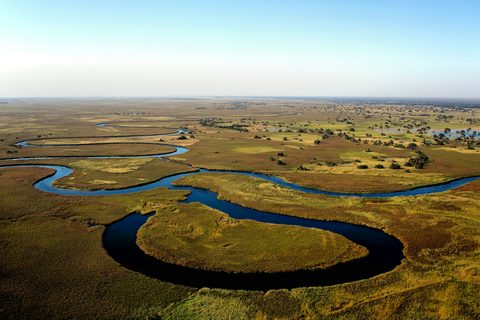
- Botswana — if you want water and low volume. The choice inside the country is the real one: a water camp gives you the mokoro and the motorboat channels, a land camp in Linyanti or the Khwai concessions gives you the predators and the walking.
- South Africa — if it is a first safari, or there are children. Best value per night of the five, short flights, and the one country here with genuine malaria-free options.
- Rwanda — if it is gorillas. A different trip entirely: trekking rather than game drives, and it pairs with a savannah country rather than replacing one.
Malaria, children and the two rules that catch people out
Two constraints decide more itineraries than budget does, and both are absolute rather than negotiable.
Malaria. The Greater Kruger is a low-risk area where prophylaxis is generally advised. If you would rather not medicate young children, South Africa is the only country on this page with excellent malaria-free reserves — in the Eastern Cape and Madikwe.
Age. Rwanda's gorilla permits carry a minimum age of fifteen, enforced without exception, and each permit is a government-issued daily place capped at eight visitors per family. Permits are secured before flights, not after.
Two countries, or one?
Seven nights in one country at the premium tier starts from US$10,000 per person before international flights. Ten to twelve nights across two countries starts from US$20,000 per person. The pairing that works most often is a savannah country with either Rwanda's gorillas or a coast, rather than two savannah countries in sequence — the second one rarely feels different enough to justify the internal flights. Our Kenya and Tanzania comparison goes deeper on the two that are most often weighed against each other, and the safari guide covers camps and seasons by region.
Namibia sits outside this table for a reason: it is a landscape safari rather than a game-density one — the Sossusvlei dunes, the Skeleton Coast, and desert-adapted elephant and rhino in the Hoanib, driven and flown between regions rather than game-driven from a single camp, May to October.
Questions, answered.
No country is best at everything, but the deciding line is whether you may leave the road. Kenya's private conservancies, Botswana's concessions and South Africa's Sabi Sand and Timbavati permit off-road driving, night drives and walking; Tanzania's national parks permit neither off-road driving nor night drives, and walking only as ranger-led outings in parks such as Tarangire and the Serengeti. For a first safari South Africa offers the best value per night and the only malaria-free options; for the rules on your side, Kenya's conservancies; for scale and the migration, Tanzania.
South Africa, on two counts. Luxury lodges start from US$1,200 per person per night, against roughly US$1,500 typical in Kenya, and the private reserves charge nothing at a gate because the conservation levy sits inside the rate. Botswana's park fees are the lowest in absolute terms — P270, about US$20 per person per day at Moremi and Chobe — but its camps price higher because the product is low bed numbers.
More than most people budget for. Two travellers on a ten-night northern circuit in Tanzania carry well over US$1,500 in fees before a single night is paid for: Serengeti US$70.80 in peak plus 18% VAT per person per day, Ngorongoro US$70.80 per adult and a further US$295 per vehicle to descend to the crater. Kenya's Maasai Mara reserve is US$100 per person per day January to June and US$200 July to December. Botswana is about US$20. South Africa's private reserves charge nothing at a gate.
South Africa. It is the only country here with excellent malaria-free reserves — in the Eastern Cape and Madikwe — for families who would rather not medicate young children, and the flights are shorter. Note the hard limit elsewhere: Rwanda's gorilla permits carry a minimum age of fifteen, enforced without exception.
Only in the right place, and it is decided by country and by land status rather than by the camp. Kenya's private conservancies such as Mara North, Olare Motorogi and Naboisho permit off-road driving to reach a sighting, night drives and guided walking, and cap vehicles per sighting. So do Botswana's private concessions and South Africa's Sabi Sand and Timbavati. Tanzania's national parks permit none of them.
Usually only if the second one is genuinely different. Seven nights in one country at the premium tier starts from US$10,000 per person before international flights; ten to twelve nights across two countries from US$20,000 per person. Pairing a savannah country with Rwanda's gorillas or with a coast works better than two savannah countries in sequence, where the second rarely feels distinct enough to justify the internal flights.
South Africa for most first safaris: the best value per night, shorter flights, the Big Five in a single private reserve, and malaria-free options in the Eastern Cape and in Madikwe, which South African Tourism calls one of the country's foremost Big Five malaria-free reserves. Kenya is the next step, with the Maasai Mara and its private conservancies; Tanzania, Botswana and Rwanda's gorillas usually make the better second safari.
It depends on where you go, and the decision belongs with a travel-medicine doctor. The CDC recommends preventive medication for Kenya below 2,500 m, game parks included, for Tanzania below 1,800 m, for Botswana's Okavango and Chobe, for all of Rwanda, and for South Africa's Kruger National Park and the north-eastern districts it lists. South Africa's Eastern Cape is outside the CDC's malaria areas, and Madikwe is described by South African Tourism as malaria-free.
Fifteen. Visit Rwanda, the country's official tourism board, sets the minimum age for gorilla tracking at 15 years old, and permits cost US$1,500 per person per night. Eight permits are issued per gorilla family per day, 96 in total across Rwanda, and each group has a strict maximum of one hour with the gorillas, which is why permits are booked as early as the rest of the safari.
The one that matches your priority, and the deciding line is whether you may leave the road. For off-road driving, night drives and walking: Kenya's private conservancies, Botswana's concessions, or South Africa's Sabi Sand and Timbavati. For scale and the migration: Tanzania. For a first safari and the best value per night, with the only malaria-free options: South Africa. Rwanda's gorillas usually make the better second safari.
Yes. In Tanzania a private vehicle is the single upgrade that changes the days of a Serengeti and Ngorongoro safari. Because Tanzania's national parks permit no off-road driving or night drives, and walking only with a ranger, the vehicle is where control comes from: it buys the departure time, the right to sit with a leopard for an hour and a row of your own for a camera. It adds from about US$250 per vehicle per day on top of the camp rate.
In Botswana the choice between a water camp and a land camp is the real decision. A water camp gives you the mokoro and the motorboat channels. A land camp in Linyanti or the Khwai concessions gives you the predators and the walking. Botswana's private concessions permit off-road driving to reach a sighting, night drives and guided walking, and the country suits travellers who want water and low volume.
Laikipia adds serious rhino populations to a Kenya safari, along with horseback and camel safaris that are rare anywhere else. It complements the private conservancies bordering the Maasai Mara, such as Mara North, Olare Motorogi and Naboisho, which have markedly lower vehicle density than the reserve and permit off-road driving to reach a sighting, night drives and guided walking.
Namibia is a landscape safari rather than a game-density one, which is why it sits apart from the Kenya, Tanzania, Botswana, South Africa and Rwanda comparison. The journey covers the Sossusvlei dunes, the Skeleton Coast and desert-adapted elephant and rhino in the Hoanib. It is driven and flown between regions rather than game-driven from a single camp, from May to October.
Botswana for water and low volume; South Africa for value, short flights and children. Botswana's private concessions offer the mokoro and motorboat channels in water camps, or predators and walking in land camps, from US$1,200 per person per night, with modest park fees. South Africa's Sabi Sand and Timbavati also start from US$1,200 per person per night, with no gate fees, and the country has malaria-free reserves. Both permit off-road driving, night drives and walking in their private areas.
A luxury safari in Africa starts from US$1,200 per person per night, all-inclusive, and around US$1,500 is typical across the region. Serengeti migration camps start from US$1,800 per person per night in season, Rwanda sits near US$2,000 before the US$1,500 gorilla permit, and park fees add most in Tanzania. Seven nights in one country at the premium tier starts from US$10,000 per person before international flights, and ten to twelve nights across two countries from US$20,000 per person.
Safaris
See the collection →Tell a private advisor how you like to travel — no quotes, no obligation.
Speak With a Luxury Travel AdvisorA real person answers: an in-house luxury travel advisor, in English or Spanish. The first conversation is complimentary.