The Best Time to Visit Australia — a Luxury Guide, Month by Month
The best time to visit Australia is September to November or March to May, when the south is mild and the crowds are lighter. Australia is a continent, with its seasons reversed from the Northern Hemisphere, so the tropical north and the Outback are at their best in the winter months, from May to September.
- The best time to visit Australia overall is spring, September to November, or autumn, March to May, which suit Sydney, Melbourne and the south.
- The tropical north, with Cairns and the Great Barrier Reef, is at its best from May to September; its wet season runs from about November to April, and marine stingers are present from November to May.
- Uluru is best from May to September, when daytime highs run between 20 and 30°C (68 to 86°F); from October to March it regularly exceeds 35°C (95°F).
- Summer, December to February, is the most expensive time to travel, and the Australian school holidays run from mid-December to late January.
- Whale season on the east coast runs from May to November, and Sydney's two big dates are Vivid Sydney, 28 May to 19 June 2027, and New Year's Eve.
- A private Australia journey starts from around US$1,500 per person per night.
The short answer
The best time to visit Australia is September to November (spring) or March to May (autumn). Those are the shoulder seasons for Sydney, Melbourne and the south: mild weather, lighter crowds and the best access to the finest houses. Australia is a continent, though, and the seasons are the opposite of the Northern Hemisphere's. The tropical north and the Red Centre are best in the cooler, drier months, May to September, and the south is at its warmest from December to February. Our rule of thumb: south in the shoulder seasons, north and Outback in the southern winter.
Australia month by month
| Months | What it is like | Best for |
|---|---|---|
| December to February | Summer in the south, and the most expensive season. Sydney averages highs of 26°C (79°F) in January, the Australian Open runs from 11 to 31 January 2027, and school holidays run from mid-December to late January. In the tropical north it is the wet season, with Cairns receiving about 436 mm of rain in February | Sydney Harbour and the beaches, New Year's Eve, tennis, Tasmania from December |
| March to May | Autumn in the south: mild days and the grape harvest, from late January in the Hunter Valley and mid-February to late April in the Barossa. The tropical north dries out from May, and humpback whales start moving north along the east coast from May | Wine country, the cities, the first of the Reef season, Ningaloo's whale sharks from March |
| June to August | Winter in the south, with July the coldest month across the continent and Sydney averaging highs of 16°C (61°F). The Red Centre and the tropical north are at their best: Cairns averages 27°C (80°F) in August with about 27 mm of rain. Vivid Sydney runs from 28 May to 19 June 2027 | Uluru, the Kimberley, the Great Barrier Reef, dwarf minke whales in June and July |
| September to November | Spring in the south: mild, blooming and quieter than summer. Humpbacks head south from August to November, the coral spawns after the October and November full moons, and the tropical north starts to heat up. Melbourne Cup is on 2 November 2027 | Sydney, Melbourne, wine country, whales, the Reef before the wet |
The south and the north on different calendars
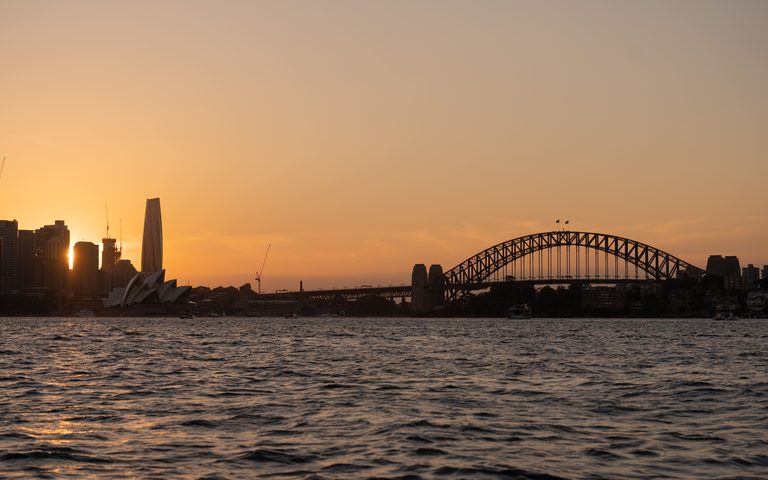
Sydney, Melbourne and the south are best in spring and autumn, with temperate days and fewer visitors than in summer. Summer is for the harbour, the beaches and outdoor dining, and it is also the peak: the Sydney New Year's Eve fireworks run at 9 p.m. and midnight, and the Sydney to Hobart yacht race starts on 26 December. Winter is mild by northern standards, with Sydney averaging 18°C (64°F) in August, and it is a good time for the city's restaurants, Vivid Sydney and the whales.
The tropical north, with Cairns, Darwin and Kakadu, runs on a wet and a dry season. The wet season is from about November to April, with heavy rain and high humidity, and the dry season is from May to September. Marine stingers are present in tropical Queensland waters all year, with the higher risk from November to May, which is why we plan the Great Barrier Reef for the cooler months, roughly May to October. The reef is also at its most spectacular for two natural events: dwarf minke whales in June and July, and the coral spawning after the full moons of October, November and December.
The Red Centre, around Uluru, is a desert. The best time to come is May to September, when daytime highs usually run between 20 and 30°C (68 to 86°F) and the nights are very cold. From October to March, highs regularly exceed 35°C (95°F), and walking stops by late morning. Western Australia has its own calendar: the Kimberley's expedition cruises run from about April to September, and Ningaloo's whale sharks from March to July. Tasmania is best from December to April.
The dates worth planning around
- Australian Open. Melbourne, 11 to 31 January 2027, with the finals on 30 and 31 January.
- Vivid Sydney. 28 May to 19 June 2027, with the lights on at 6 p.m. every night.
- Melbourne Cup. Tuesday 2 November 2027.
- Sydney New Year's Eve. The Harbour fireworks at 9 p.m. and midnight; the vantage points on the water are reserved many months ahead.
- Sydney to Hobart. The yacht race starts every year on 26 December.
- Whales. Humpbacks migrate along the east coast from May to November, and dwarf minke whales visit the Great Barrier Reef in June and July.
- School holidays. In New South Wales the summer holidays run from 18 December 2026 to 27 January 2027, and Victoria and Queensland are similar, which is when domestic travel peaks.
The cheapest time to go
Tourism Australia lists December to February as the high season, and says summer is the most expensive time to travel in Australia. June to August is its low season, with the important exception of Cairns and the Great Barrier Reef, where those months are peak. March to May and September to November are the shoulder seasons, which is why they are also our recommendation: mild weather and lighter crowds without the summer premium. Our best lodges and island houses are few, so they are reserved well ahead in every season.
How many days are enough
For Australia, our starting points run from four to fourteen days. Sydney and the coast takes four to six days, the Great Barrier Reef and the Daintree six to eight, and New Zealand's South Island seven to ten; to combine both countries, The Grand South Pacific is a twelve to fourteen day journey. The distances are the real cost: Sydney to Cairns is a three-hour flight, and each region we add is a flight and half a day.
How to see it in luxury
The month sets the order of the trip. In spring and autumn we start in Sydney and the wine country; in the southern winter, with Uluru, the Reef and the Kimberley, and Sydney at the end for Vivid. On the Reef, a seaplane to a sandbar and a private island house are arranged around the tide and the season. See Australia and New Zealand, Sydney and the Great Barrier Reef, and our Sydney & the Coast and Reef & Rainforest journeys; where to go and what each costs is in the luxury Australia and New Zealand guide.
What a luxury Australia journey starts from
As a luxury advisory we quote a from-price, not a final one. A private Australia journey starts from around US$1,500 per person per night, before international flights, and rises with private guiding on the Reef, helicopter days, remote lodges and the length of the trip. Your Forest Travel advisor gives the exact figure for your dates.
For the luxury window of every destination on one page, see the best time to visit, by destination.
Questions, answered.
The best time to visit Australia overall is September to November or March to May, the shoulder seasons for Sydney, Melbourne and the south. The tropical north and the Red Centre are best from May to September, in the cooler, drier months. Forest Travel's rule of thumb: the south in spring and autumn, the north and the Outback in the southern winter.
There is no single month for a continent. October and November suit Sydney, Melbourne and the wine regions, April and May the south and the start of the Reef season, and June to August the Red Centre, the Kimberley and the Great Barrier Reef. For one month that works across most of the country, choose May or September.
Tourism Australia lists June to August as the low season and December to February as the high season, when summer is the most expensive time to travel. The exception is the tropical north, where June to August is peak season in Cairns and on the Great Barrier Reef. The shoulder seasons, March to May and September to November, balance weather and price.
For a private luxury journey, calculate from around US$1,500 per person per night, so thirteen nights start from US$19,500 per person, before international flights. The figure covers the houses, private guiding and the internal flights between regions, and it rises with Reef seaplane days, helicopter flights and remote lodges. Your advisor gives the exact figure.
Mild in the south and warm in the north. In August Sydney averages highs of about 18°C (64°F) with 80 mm of rain, Melbourne about 16°C (60°F), and Cairns about 27°C (80°F) with only 27 mm. It is the southern winter, the best season for Uluru and the Reef, and the coldest month across the continent is July.
Four to fourteen days, depending on the journey. Sydney and the coast takes four to six days, the Great Barrier Reef and the Daintree six to eight, and combining Australia with New Zealand's South Island twelve to fourteen. Distances are large, so each region added is a flight and half a day, and we weight a trip to two or three regions.
May to October is the dry season in the north, and the window we plan the Reef around. Marine stingers are present in tropical Queensland waters all year, with the higher risk from November to May. Dwarf minke whales visit in June and July, and the coral spawns after the October to December full moons.
Usually, yes. From October to March, daytime highs at Uluru regularly exceed 35°C (95°F), and January averages about 38°C (101°F), so walking stops by late morning. Parks Australia recommends May to September, when highs run between 20 and 30°C (68 to 86°F), though winter nights are very cold, close to 4°C (40°F) in July.
Australia & New Zealand
See the collection →Tell a private advisor how you like to travel — no quotes, no obligation.
Speak With a Luxury Travel AdvisorA real person answers: an in-house luxury travel advisor, in English or Spanish. The first conversation is complimentary.